



In today’s highly competitive global supply chain for decorative materials, “color-difference control” is no longer just a part of quality management—it has become a core criterion for evaluating a manufacturer's professionalism, stability, and reliability. Especially for decorative acrylic sheet, a material that relies heavily on visual expression, even a tiny color difference of 0.3 can disrupt the visual harmony of commercial spaces and potentially damage brand image. Therefore, how to control the color difference of decorative acrylic sheets has become one of the most frequently discussed and continuously optimized topics in the industry.
As a manufacturer with years of experience in decorative materials, Hantai has established a highly rigorous, systematic, and measurable color-difference control process through long-term production practice. From raw-material selection, in-process color checking, and full inspection to final delivery supported by color-difference measurement devices, we understand clearly that the color performance of decorative acrylic sheet is not accidental—it is the result of precise coordination across all stages. This article takes an industry-focused perspective to explore this topic from multiple angles—technical processes, manufacturing capabilities, and system management—to thoroughly answer a central question: How to control the color difference of decorative acrylic sheets?
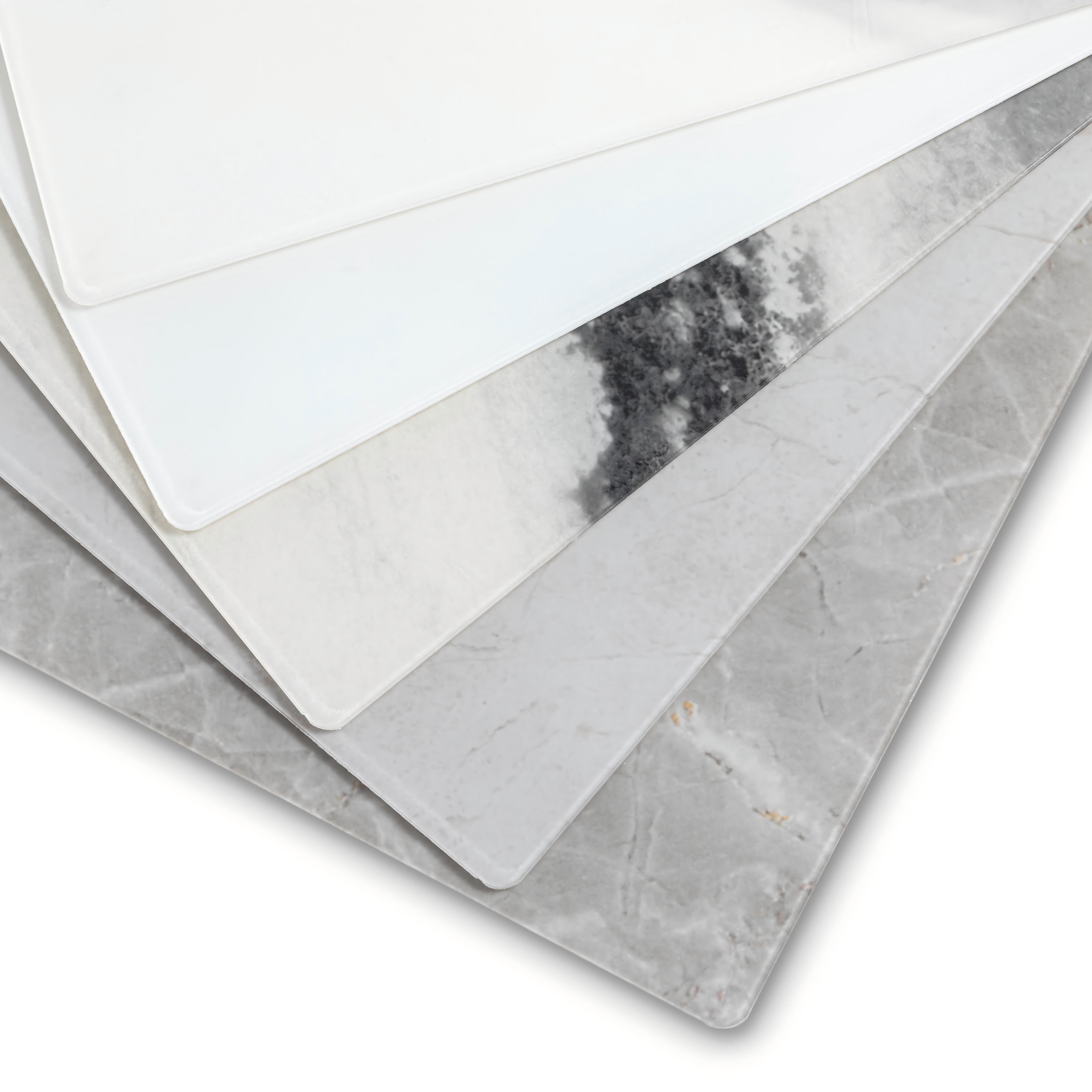
Why Does Color Difference Become the Most Sensitive Issue in the Production of Decorative Acrylic Sheets?
To understand how to control color difference, we must first understand why decorative acrylic sheet is so sensitive to color variations.
Decorative acrylic sheet consists of two primary components:
Transparent acrylic layer (determines gloss, clarity, and light refraction)
PVC decorative film (determines final color, texture, and style)
The combination of the transparent layer and decorative film creates richer visual depth under lighting compared to ordinary panels. This visual advantage also makes color differences more visible. For example:
Slightly darker PVC film will appear even deeper through the acrylic layer
Acrylic with yellowish transparency makes the overall sheet look “aged” or dull
Batch differences in decorative PVC film cause inconsistent wood-grain or stone-grain effects
In other words, even a minor deviation may be magnified significantly in the finished product.
Therefore, controlling the color difference of decorative acrylic sheet requires systematic management from source, process, and final inspection.
How Do Raw Materials Determine the Color Accuracy of Decorative Acrylic Sheets? Why Are Raw Materials the First Key?
In Hantai’s quality-management system, raw materials have always been the most critical foundation for controlling color differences. Approximately 60% of final color stability in decorative acrylic sheet depends on the consistency of raw materials.
① Transparent Acrylic Sheet: Transparency, Gloss, and Impurities Define the “Base Tone”
Transparent acrylic is not considered “good” simply because it looks clear. Three factors influence the final color appearance:
Light-transmittance stability across batches
Intrinsic tone—whether it appears bluish, yellowish, or grayish
Impurity levels that may affect clarity or cause a “milky” effect
Differences in transmittance alter the perceived depth of the PVC film;
higher impurity levels create dullness;
slight yellowing distorts cool-tone textures.
Hantai’s acrylic-sheet procurement requires:
Controlled transmittance differences between batches
No visible impurities
No surface waves or subtle tone deviations
Optical-instrument inspection for every batch
We understand very well that even minor color deviation in the transparent layer directly influences the overall appearance of decorative acrylic sheet—therefore, this stage is non-negotiable.
② PVC Decorative Film: The Color-System Foundation and the “Soul of the Style”
The PVC film determines the visual style of the finished decorative acrylic sheet. It must meet strict standards:
Stable color across batches
Clear printed patterns
No ink color deviation
No lamination defects
No banding or color breaks
All PVC decorative films used by Hantai are designed and produced by our in-house team, allowing us to control:
Color-system consistency
Standardized printing
Batch-level color monitoring
Stable mass-production quality
Only when raw materials are consistent can subsequent processes remain controllable.
Why Does Every Production Step Matter for Color Control? Why Must Every Process Include Color Checking?
Even if raw materials are perfectly consistent, variations in production parameters can still lead to color differences in decorative acrylic sheet. For this reason, Hantai enforces strict standards throughout production:
Color-matching at every processing step
Sample boards used as the reference
Same workers handling the same batch from start to finish
Accurate recording of all process parameters
Below are the key production steps influencing color difference:
① Glue-Lamination: Speed, Temperature, and Pressure Affect the Final Color Appearance
Transparent acrylic and PVC film are bonded using adhesive. Variations in lamination conditions directly influence:
Adhesive thickness
Light penetration
Surface refraction
Panel brightness and reflectiveness
Hantai uses automated constant-temperature and constant-pressure lamination equipment to ensure that every decorative acrylic sheet has a consistent adhesive layer—eliminating color changes caused by uneven bonding.
② Post-lamination Initial Inspection: Manual Checking + Light-box Verification
Initial inspection includes:
Standard-light-source light-box examination
Manual visual comparison
Comparison against sample boards and batch references
Color-inspection criteria include:
Brightness consistency
Tone consistency
Color-temperature uniformity
No dullness or yellowing
This step ensures early detection of issues, allowing timely adjustments and avoiding batch-level defects.
③ Pre-cutting and Post-polishing Review: Checking Edge-Color Uniformity
Different light angles may cause different perceived tones. Therefore, Hantai performs color-difference checks:
Before cutting
After polishing
ensuring that no processing step affects the final appearance.

Why Is Final Inspection Critical for Color Reliability? Why Is Color-Difference Meter (ΔE) Testing Essential for Delivery?
Color consistency cannot rely solely on visual judgment. Hantai applies the strictest industry standards for final inspections.
① Color-Difference Meter (ΔE) as the Final Judgment Standard
All finished decorative acrylic sheets must pass:
Color-difference testing between samples and batch production
ΔE readings within the approved range
Automatic rejection of abnormal sheets
If ΔE exceeds the limit:
Data is recorded
QC department is notified
Samples are preserved
Customer receives data for confirmation
Reproduction is arranged if needed
This ensures:
Transparent color data
Traceable quality history
Standardized measurable results
② Independent Color-Difference Records for Every Batch
For every model of decorative acrylic sheet, Hantai maintains:
Color-difference data
Raw-material batch numbers
Process parameters
Lamination temperature
QC checklists
This creates full traceability and long-term stability.
Why Can Hantai Ensure Better Color Control for Decorative Acrylic Sheets?
Hantai’s advantages stem from three main factors:
① Fully Controlled Raw-Material System
Since we design and produce PVC decorative films in-house, we can:
Maintain batch-level color consistency
Adjust color deviations quickly
Keep textures visually continuous
Ensure stable supply for mass-production orders
Acrylic sheets are also sourced from stable suppliers, ensuring reliable consistency.
② Advanced Lamination Equipment Reduces Process-Related Color Differences
We use:
Constant-temperature lamination
Precision-pressure control
High-speed automated bonding lines
These allow every decorative acrylic sheet to be produced under strict process controls.
③ Comprehensive Color-Difference Inspection System
Hantai’s QC process includes:
Raw-material color checking
In-process color comparison
Light-box validation
Final ΔE measurement
Sample retention
Data archiving
Multiple layers of control ensure high color accuracy and reliability.
How Can Stable Color Control Enhance the Value of Decorative Acrylic Sheets?
In commercial spaces and residential interior design, decorative acrylic sheet has become an important material known for visual effect. Stable color-difference control is essential for its wide application.
Stable color control can:
Enhance the premium visual feel
Maintain design consistency
Reduce risks for designers and contractors
Increase product value
Strengthen customer trust
Hantai will continue to uphold:
Stricter raw-material screening
More refined process management
More professional color-difference testing
More mature data-management systems
to deliver decorative acrylic sheets that are stable, high-quality, and visually refined.
If you're looking for decorative acrylic sheets with reliable color consistency, excellent quality, and premium aesthetics, feel free to contact us. Hantai looks forward to exploring more possibilities with global partners—ensuring every color is precisely presented.